
Happy ever after, 2025, oils on chestnut wood, image 28 x 17 cm
In Liguria there is a village on the coast called Sori. It has a small cemetery in which the family tombs are like small buildings positioned near a steep cliff so that they have beautiful views over the sea. Relatives coming to visit the tombs and put flowers on them can enjoy the setting, and I guess that they feel happy about their deceased loved ones enjoying the same magnificent views in some mysterious way. So I imagined a happy fungal couple revelling in the same scenery.
This is the first painting directly inspired by the chestnut forests of Fossarino. It is painted on an old chestnut board that I found in one of the outbuildings. I was fascinated by the warm, weathered textures of the timber and so I hollowed out a rectangular space on which to paint the picture directly onto the wood. It took a lot of work with a router and it was difficult to get a perfectly flat surface. I like the idea of the painting and frame being made from the same single piece of wood.
Many thanks to my sister Kathy who gave me advice on the title. My original idea was "And they lived...". Kath said that "Happy ever after" was better.
This is the first painting directly inspired by the chestnut forests of Fossarino. It is painted on an old chestnut board that I found in one of the outbuildings. I was fascinated by the warm, weathered textures of the timber and so I hollowed out a rectangular space on which to paint the picture directly onto the wood. It took a lot of work with a router and it was difficult to get a perfectly flat surface. I like the idea of the painting and frame being made from the same single piece of wood.
Many thanks to my sister Kathy who gave me advice on the title. My original idea was "And they lived...". Kath said that "Happy ever after" was better.

The tree's voyage, 2012, acrylics on paper
Said the traveller to the wise man, “That tree at the top of the rock, where there is little soil and no rain for three months, and where it is battered by salty wind and burning sun, it lives every day, and transpires. But from whence does it get the water it needs?”
Said the wise man to the traveller, “In nature, for every path that you see, there are another hundred invisible to man, and the tree knows those paths better than any man ever shall. And it probes the crevices around it in an incessant voyage of discovery.”
Asked the traveller, “So what can I learn from that tree?”
Said the wise man, “When you journey, the experience is what lies around you. So savour all that you find, the people, the plants, the symphony of wind and waves, the fragrance of the breeze and the colour of the sky.
“The destination is nothing, and neither the distance, because the journey of understanding begins and ends wherever you are. And that, my friend, is the voyage of the tree.”
(Text by Johann with apologies to Khalil Gibran)
I have always been amazed to see trees growing right at the top of a hill or mountain, and surviving even through summer months where in Italy rainfall is virtually zero. Where do trees, which have to transpire litres and litres of water every day just to survive, find their supplies? The only explanation that I can think of is that there are paths of water underground that people cannot fathom or even expect, but that trees can find and use for their survival.
Said the wise man to the traveller, “In nature, for every path that you see, there are another hundred invisible to man, and the tree knows those paths better than any man ever shall. And it probes the crevices around it in an incessant voyage of discovery.”
Asked the traveller, “So what can I learn from that tree?”
Said the wise man, “When you journey, the experience is what lies around you. So savour all that you find, the people, the plants, the symphony of wind and waves, the fragrance of the breeze and the colour of the sky.
“The destination is nothing, and neither the distance, because the journey of understanding begins and ends wherever you are. And that, my friend, is the voyage of the tree.”
(Text by Johann with apologies to Khalil Gibran)
I have always been amazed to see trees growing right at the top of a hill or mountain, and surviving even through summer months where in Italy rainfall is virtually zero. Where do trees, which have to transpire litres and litres of water every day just to survive, find their supplies? The only explanation that I can think of is that there are paths of water underground that people cannot fathom or even expect, but that trees can find and use for their survival.

Mammoth leaves field, 2009, acrylics on canvas, 120 x 55 cm
This picture is partly about reminiscence of my home country, but for me it is also linked to my aunt Pim, sadly no longer with us, who loved sport even though she had to live with a degree of physical handicap caused by polio when she was young. “It’s a perfect depiction of how people who are different in some way are excluded from society,” said Pim. That hadn’t been my intention but her interpretation adds a lot to the painting, at least for me. And I find it sad that today, other species are walking towards their extinction as a result of their loss of habitat caused by mankind’s relentless expansion.

Wave, 1994, oils on canvas, 142 x 81 cm
Why the glasses above the wave? I guess, to suggest the immense, unfathomable intelligence of the world’s oceans. But I first started making sketches of glasses back in about 1985 when I was studying in Milan. At that time, a common scene on Milan’s streets was for immigrants to spread a white cloth onto the pavement and arrange a series of sunglasses that they would sell to passers-by. I did several still-life paintings based on those scenes, but then I thought that it would be good to put them into flight.

Playing trees (study), 2007, acrylics and oils on canvas, 2007.
Study for a painting.
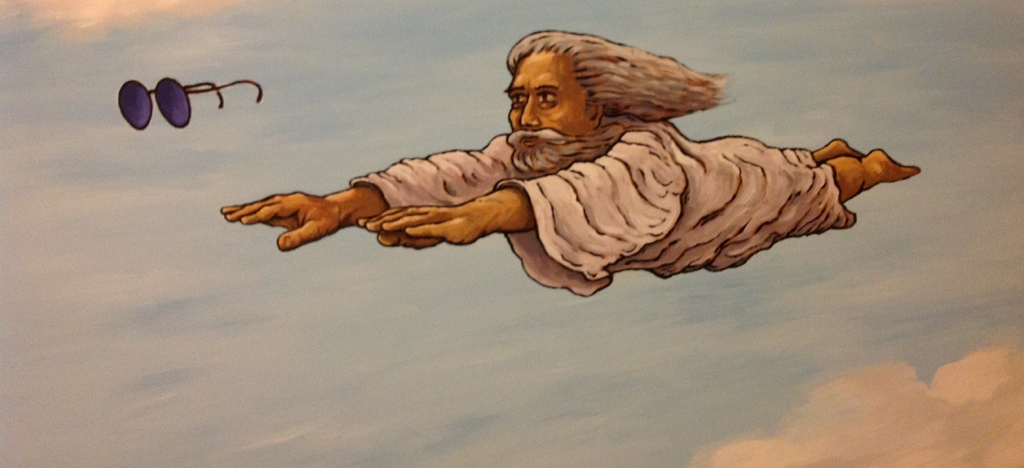
The patriarch, 2011, acrylics on canvas, 140 x 55 cm
I guess he’s Leonardo…

Tomorrow's forest, 2016, acrylics and oils on canvas, 50 x 30 cm
Many of my pictures are like sketches for an installation, but this one particularly so.

Intelligent tree, 2015, acrylics on paper, 40 x 50 cm

The tyre shop miracle, 2004, acrylics on canvas
This picture is based on a fairly familiar scene in Milan, where tyre shops often stack up the old tyres that will be picked up and disposed of, leaving them in a column outside the garage. I liked the idea of a column of tyres blossoming into a tree, which in a way seems appropriate considering that rubber is made by plants.

Wave, 1995, acrylics, oils and gold leaf on canvas
Currently in Brisbane, Australia

I'm a dreamer, self-portrait with green hair, 2011, acrylics on canvas, 50 x 54 cm
When I had hair, I thought that getting it mown would be cheaper than going to the barber's shop.
I wanted to give the picture an unfinished look. In Milan and other Italian cities, there are some buildings that were never properly completed because the money ran out. Such as churches with rough brick façades that should have been faced with marble cladding slabs that were never added. Some of Leonardo da Vinci's paintings have the same unfinished look, but in his case, he probably just lost interest and moved onto something else, like flying machines.
I wanted to give the picture an unfinished look. In Milan and other Italian cities, there are some buildings that were never properly completed because the money ran out. Such as churches with rough brick façades that should have been faced with marble cladding slabs that were never added. Some of Leonardo da Vinci's paintings have the same unfinished look, but in his case, he probably just lost interest and moved onto something else, like flying machines.

Il lento sciabordio delle stelle, 1994, oils on canvas, 159 x 96 cm.
I painted this after having seen an island in the Mediterranean when sailing with my friend Renato Cacciapuoti. I was amused to read a description in Stephen Hawking’s book A Brief History of Time. “A well-known scientist (some say it was Bertrand Russell) once gave a public lecture on astronomy. He described how the earth orbits around the sun and how the sun, in turn, orbits around the centre of a vast collection of stars called our galaxy. At the end of the lecture, a little old lady at the back of the room got up and said: ‘What you have told us is rubbish. The world is really a flat plate supported on the back of a giant tortoise.’ The scientist gave a superior smile before replying, ‘What is the tortoise standing on?’
‘You’re very clever, young man, very clever,’ said the old lady. “But it’s turtles all the way down!'”
The title was provided by another friend from years back, Alessandra Businaro, who for a time wrote articles for the local Milan paper “La Voce di Zona 3” that I was then directing.
‘You’re very clever, young man, very clever,’ said the old lady. “But it’s turtles all the way down!'”
The title was provided by another friend from years back, Alessandra Businaro, who for a time wrote articles for the local Milan paper “La Voce di Zona 3” that I was then directing.

Progress - the oxygen machine, 1994, acrylics on canvas, 65 x 52 cm

Aspettando Leonardo/Waiting for Leonardo, 1996, oils on canvas, 60 x 90 cm
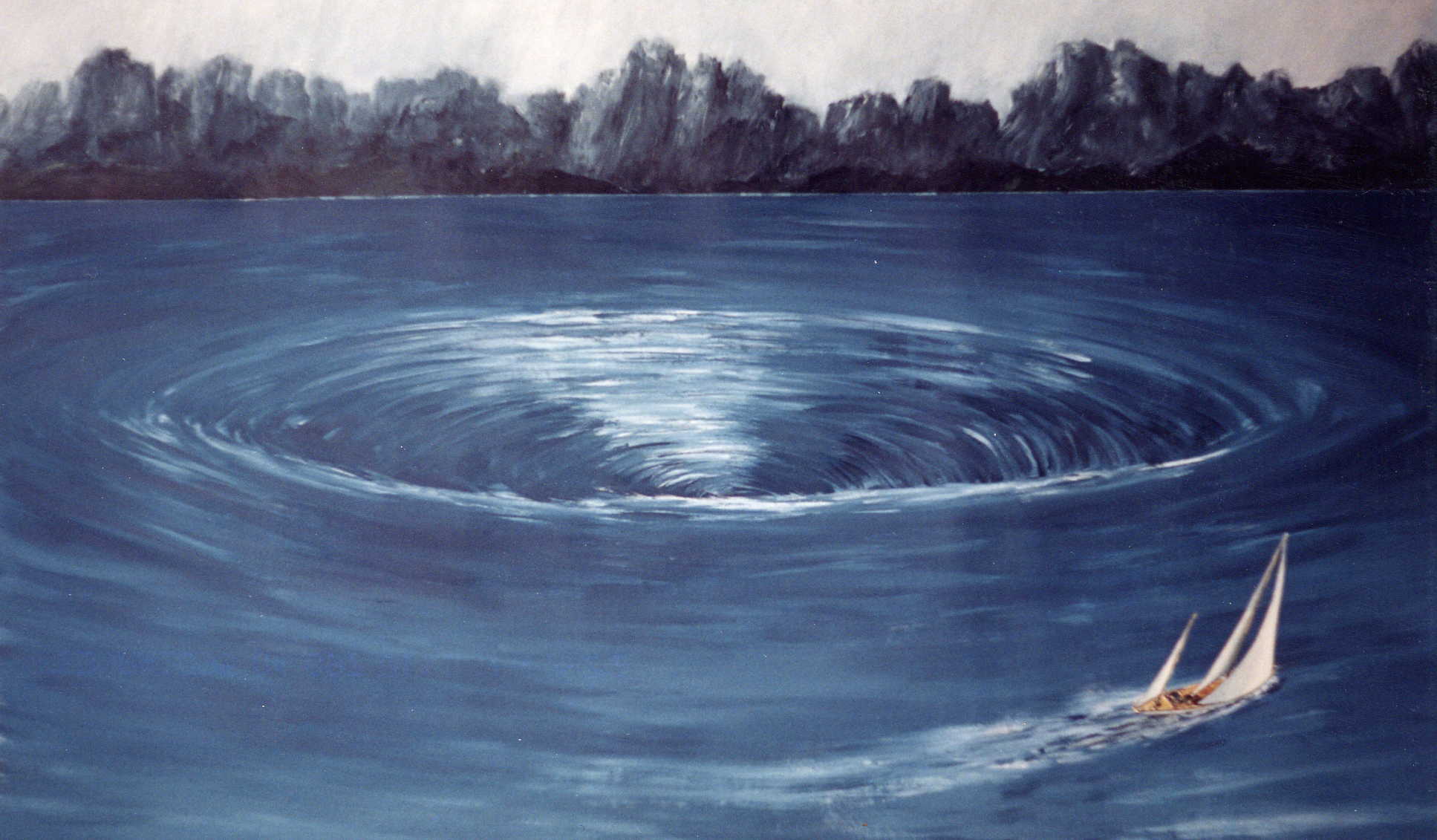
La barca degli ottimisti, 1994, oils on canvas, 160 x 93 cm
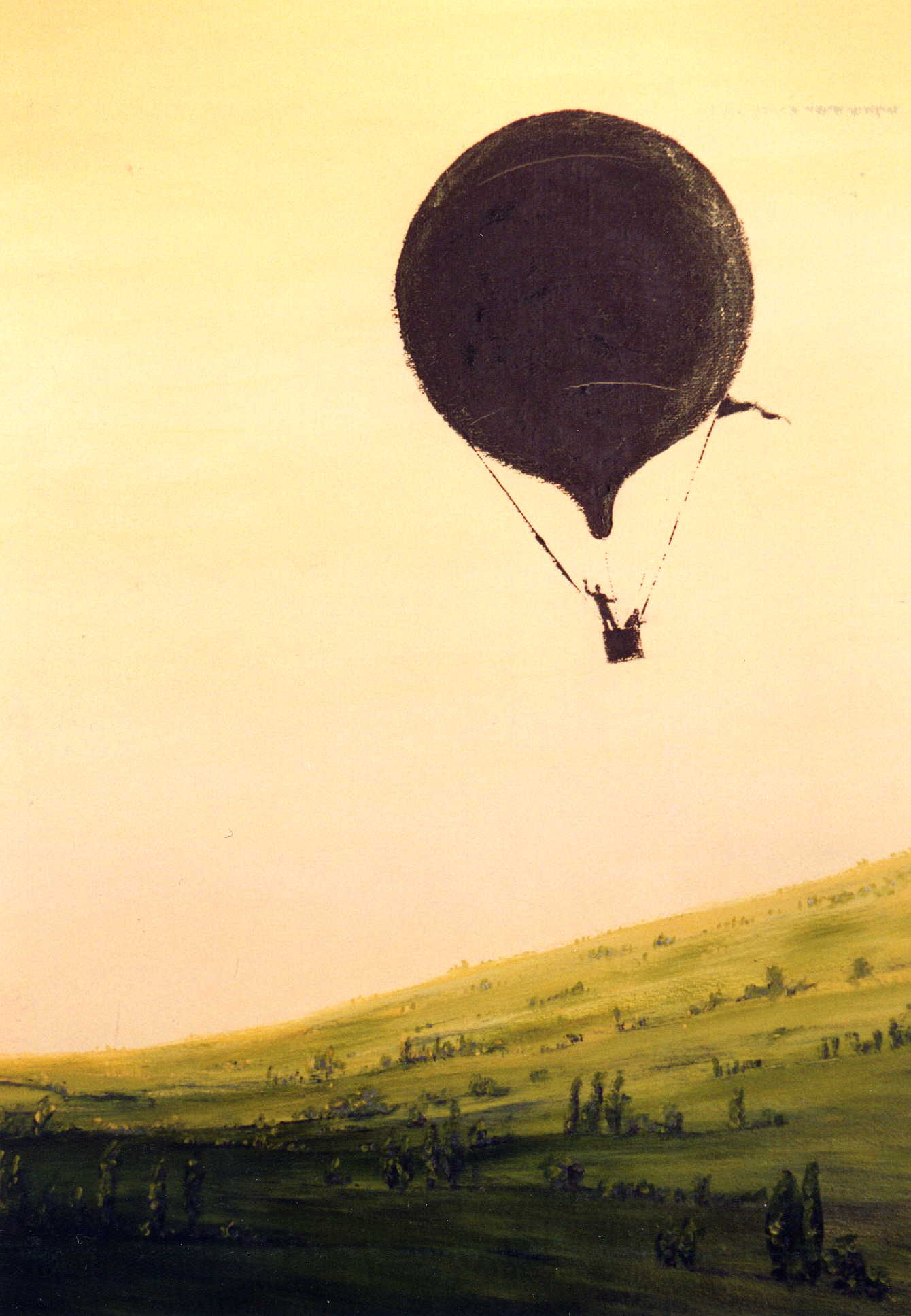
Esperimento di volo, 1995

Narcissistic duck, 2006, oils on canvas, 60 x 98 cm
Narcissus was an Ancient Greek character who, according to legend, was so handsome that he fell in love with his own reflection on the surface of a lake, fell in and drowned. A narcissistic duck would have better luck.
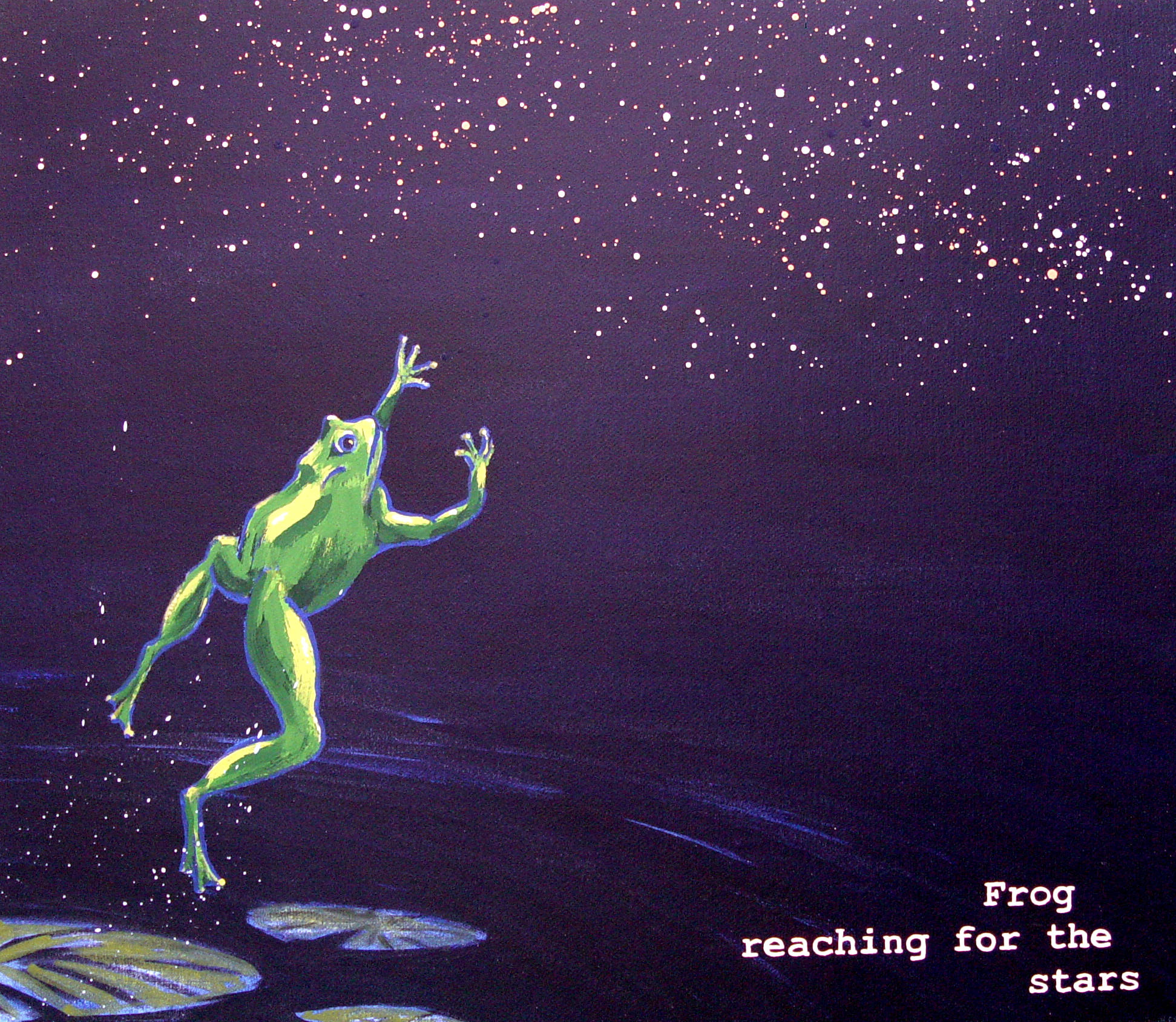
Frog reaching for the stars, 2010, acrylics on canvas, 75 x 65 cm
This is about my love of flying. From my studio in the chestnut forest of Fossarino, Rossiglione, the stars are an amazing sight and don't seem all that far off. So the fact that they are countless light-years away - so distant that even if there were life there, we would never be able to make contact with them because light or radio signals would take so long to cover the distance - makes me wonder about the Creation, and why we are compelled to come to terms with the realisation that, even though there may be intelligent life somewhere in the universe, we're never going to be able to say hello.
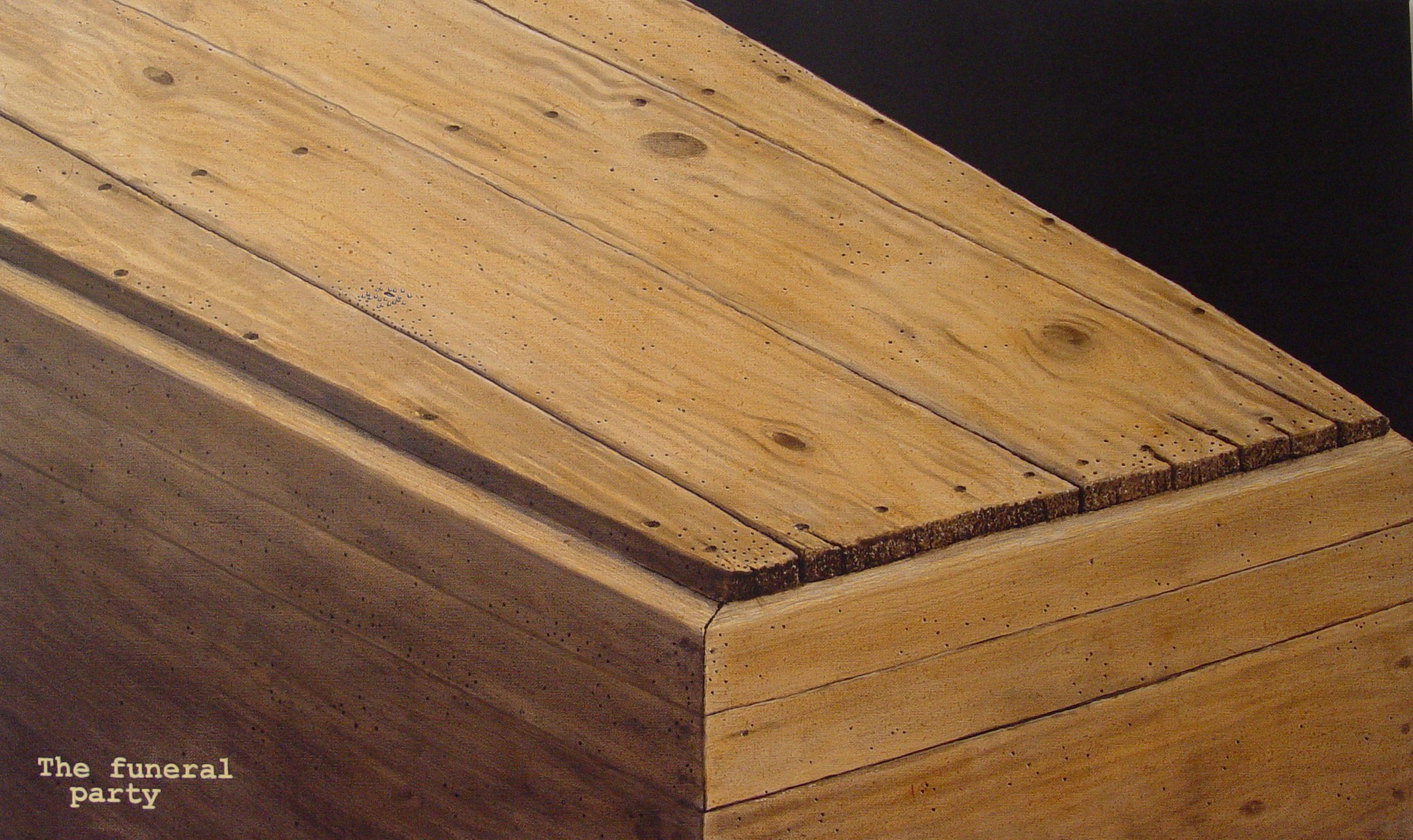
The funeral party (wake for a woodworm), 2009, oils on canvas, 151 x 90 cm
"Wake for a woodworm" is a fairly large painting when compared to my usual sizes. It developed from some other paintings of woodworm, arranged so that the woodworm are conducting a wake grouped around a coffin-shaped cavity excavated into the surface of the timber for the burial of a deceased woodworm. What would be a good timber object on which to place this composition? A coffin seemed apt. I liked the idea of the painting being difficult to reproduce in print or photographs, because the central scene – the wake – is so small. You can see a detail in the next gallery image.
The title was provided by my sister Katharine. My first idea was simply “The funeral party.” She said that "Wake for a woodworm" was much better.
The title was provided by my sister Katharine. My first idea was simply “The funeral party.” She said that "Wake for a woodworm" was much better.
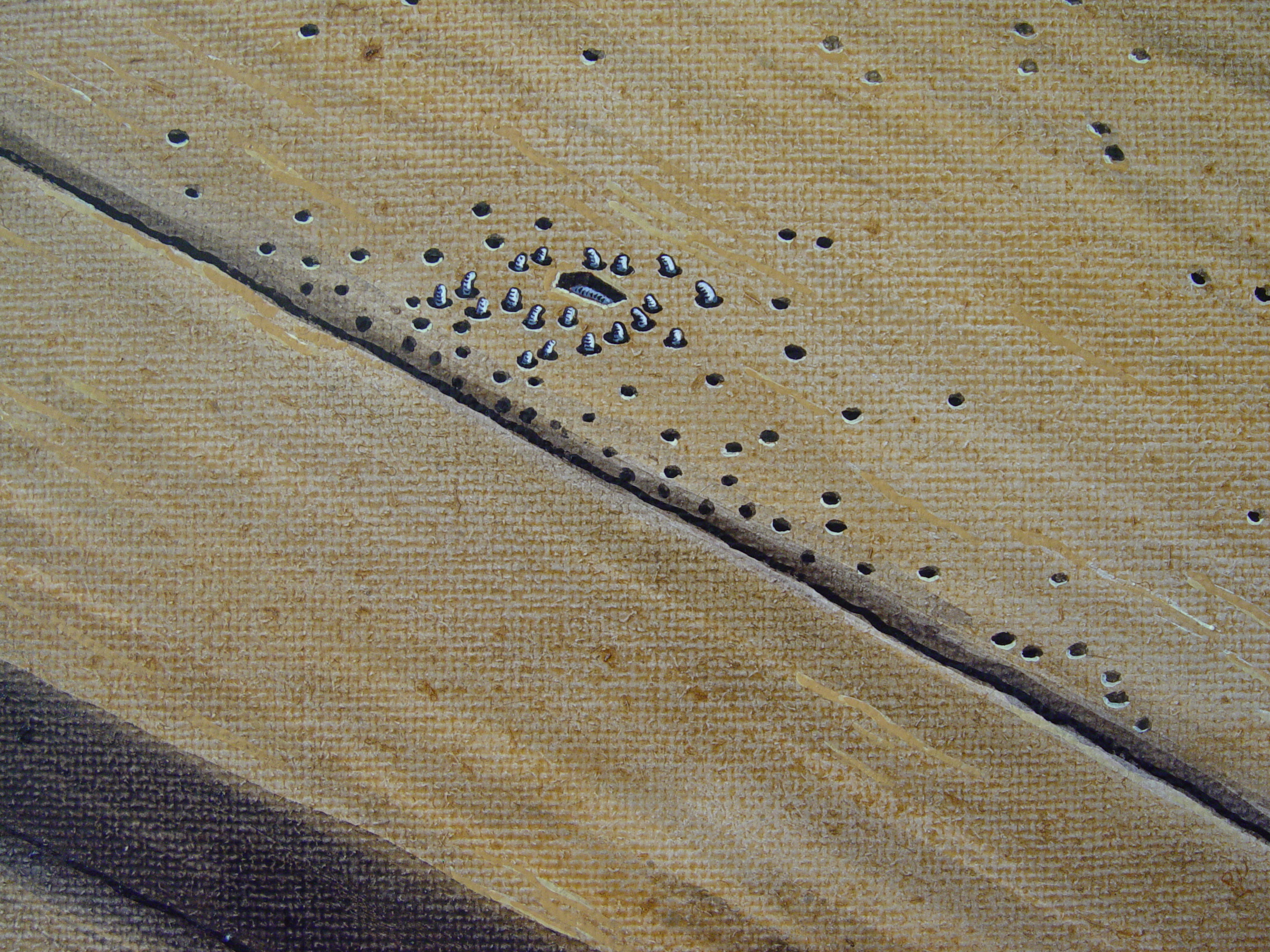
The funeral party (wake for a woodworm), detail

Wave, 2000, oils and faux gold leaf on wood, 30 x 42 cm
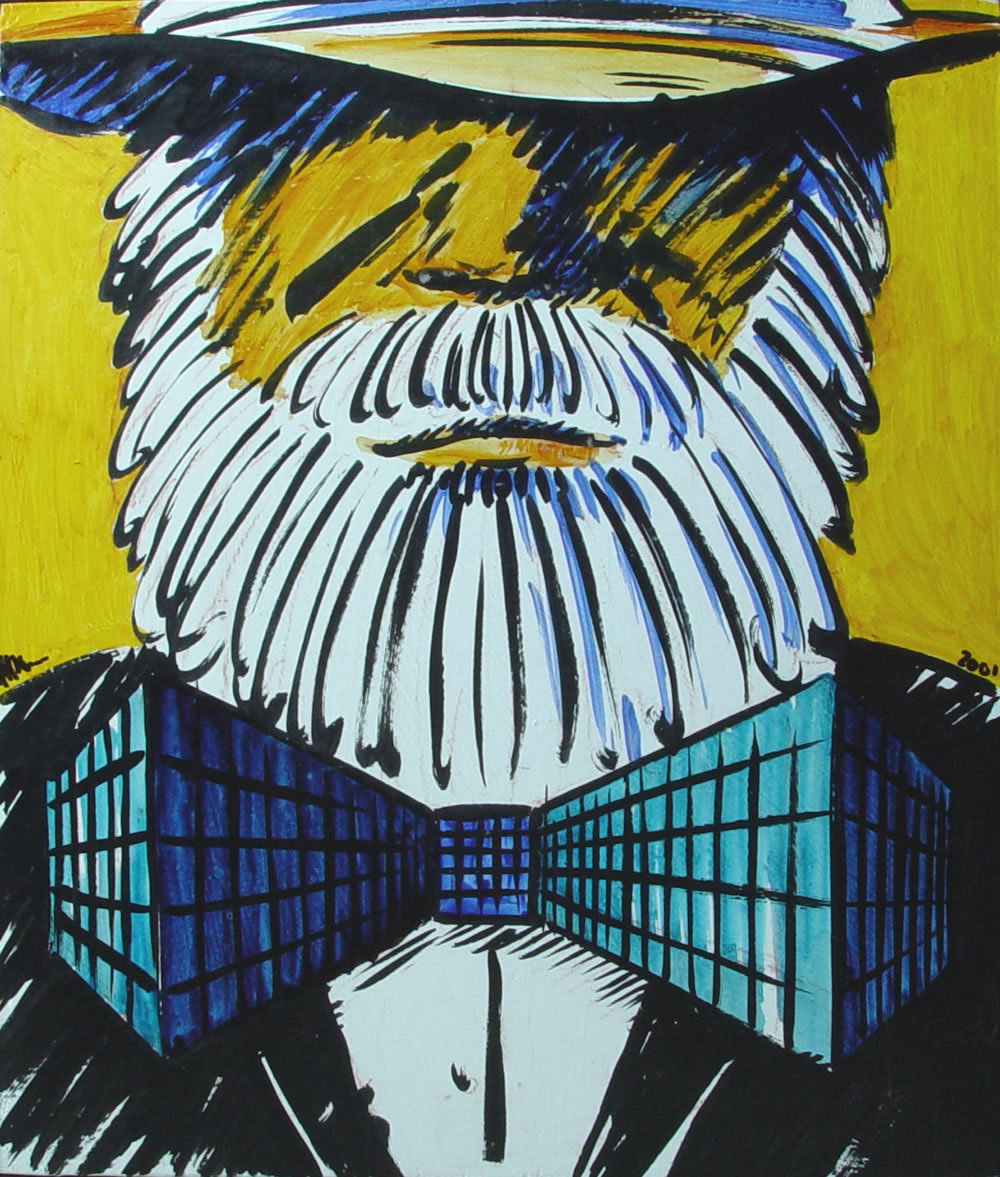
The architect and his bow tie, 1999, acrylics on wood, 30 x 35 cm
This was inspired by my architect friend Luciano.
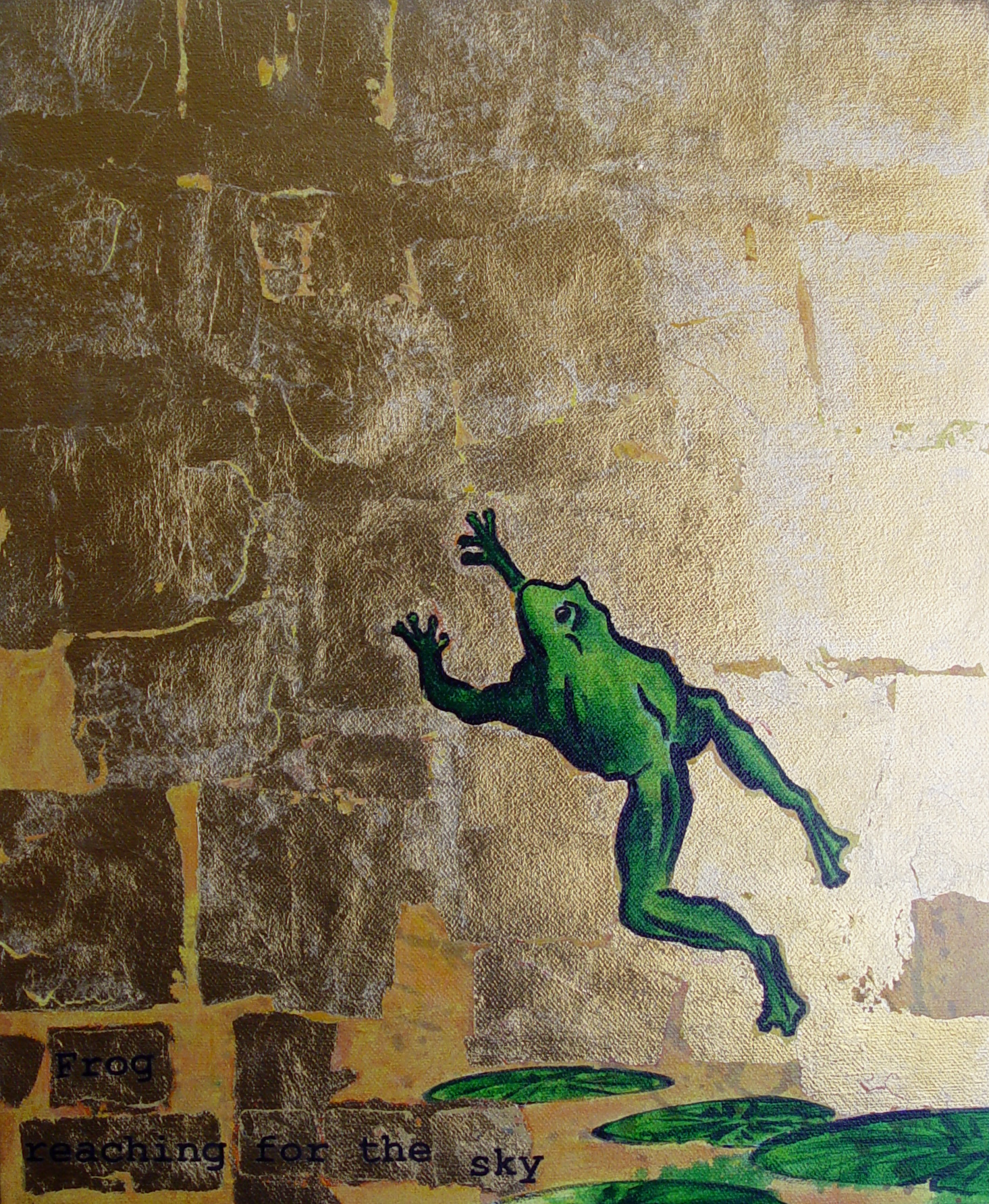
Frog reaching for the sky, 2011, acrylics and faux gold leaf on canvas, 60 x 73 cm
I think that my fascination with flight began from when my father put me - aged probably four or five - onto our upright piano and encouraged me to jump. He caught me, of course, and put me back up onto the piano so that I could repeat the operation. Which I did, many times.
About 35 years later, I decided to start hang gliding, so I consider the "Frog reaching for the sky" painting to be a sort of self-portrait. Over the course of 20 years I discovered, to my cost, that we are not all equal, and that my reaction speed and my limited ability to make quick, sound decisions were not good enough for a sport of this nature. I had a few rough landings, but also a world of enjoyment, until a building side accident forced me to abandon my dream of flight.
So the frog is basically me, struggling to leap into the air, and succeeding for a brief time before splashing back down into the pond. Immense thanks to my amazingly patient instructors Renato Fontana, Ignazio Bernardi (Garda Flying Paradise), Flavio Tebaldi (manager of the very successful Italian hang gliding team), Christian Ciech, a superb pilot who has won many world championship titles, and the fantastic crowd of flyers at Delta Club Laveno on Lake Maggiore, Italy.
About 35 years later, I decided to start hang gliding, so I consider the "Frog reaching for the sky" painting to be a sort of self-portrait. Over the course of 20 years I discovered, to my cost, that we are not all equal, and that my reaction speed and my limited ability to make quick, sound decisions were not good enough for a sport of this nature. I had a few rough landings, but also a world of enjoyment, until a building side accident forced me to abandon my dream of flight.
So the frog is basically me, struggling to leap into the air, and succeeding for a brief time before splashing back down into the pond. Immense thanks to my amazingly patient instructors Renato Fontana, Ignazio Bernardi (Garda Flying Paradise), Flavio Tebaldi (manager of the very successful Italian hang gliding team), Christian Ciech, a superb pilot who has won many world championship titles, and the fantastic crowd of flyers at Delta Club Laveno on Lake Maggiore, Italy.

Fish flying, 2006, acrylics on wood, 52 x 30 cm
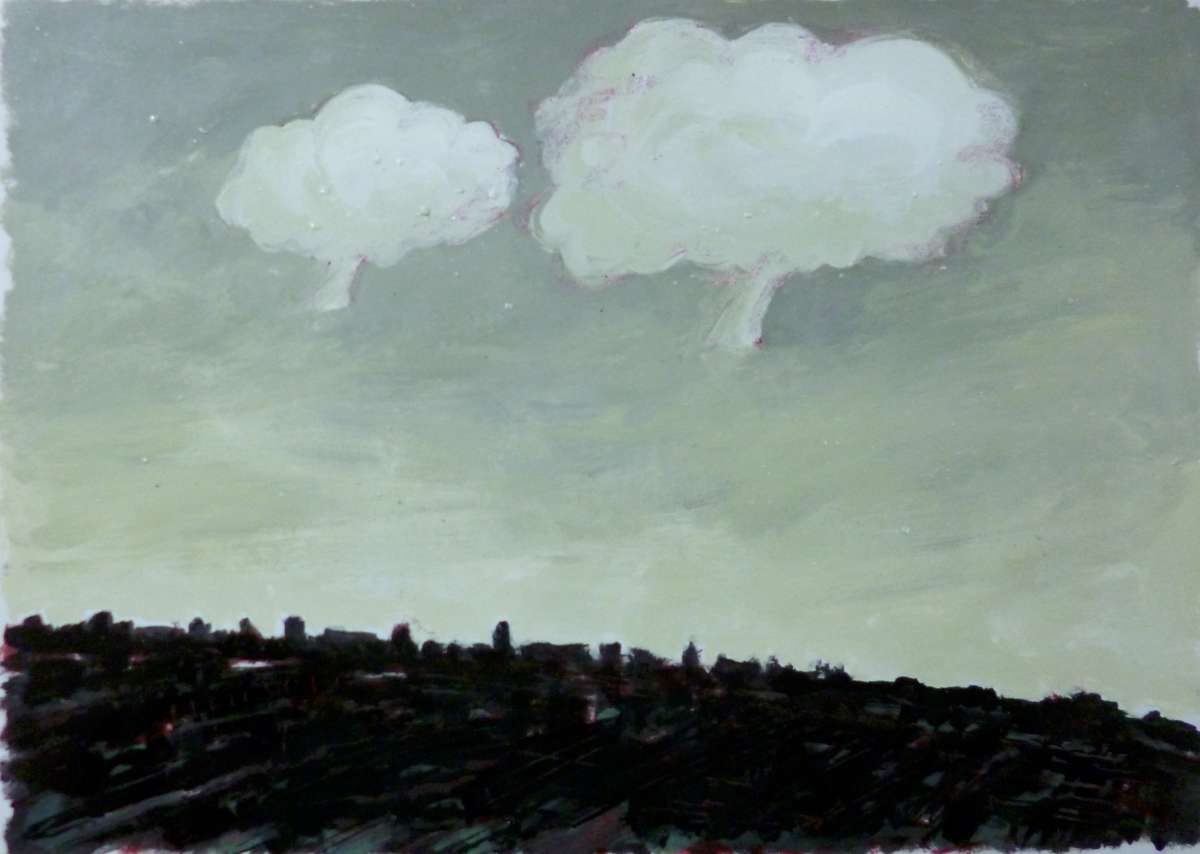
Memory of trees, 2013, oils on paper, 42 x 29 cm
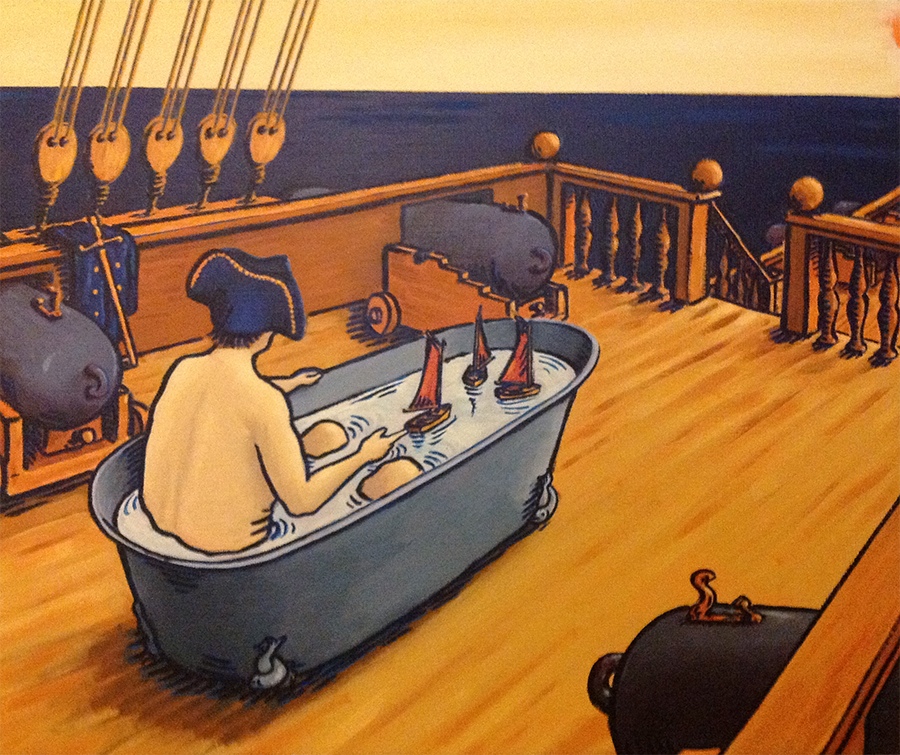
Nelson takes a bath (on his battleship), oils on wood
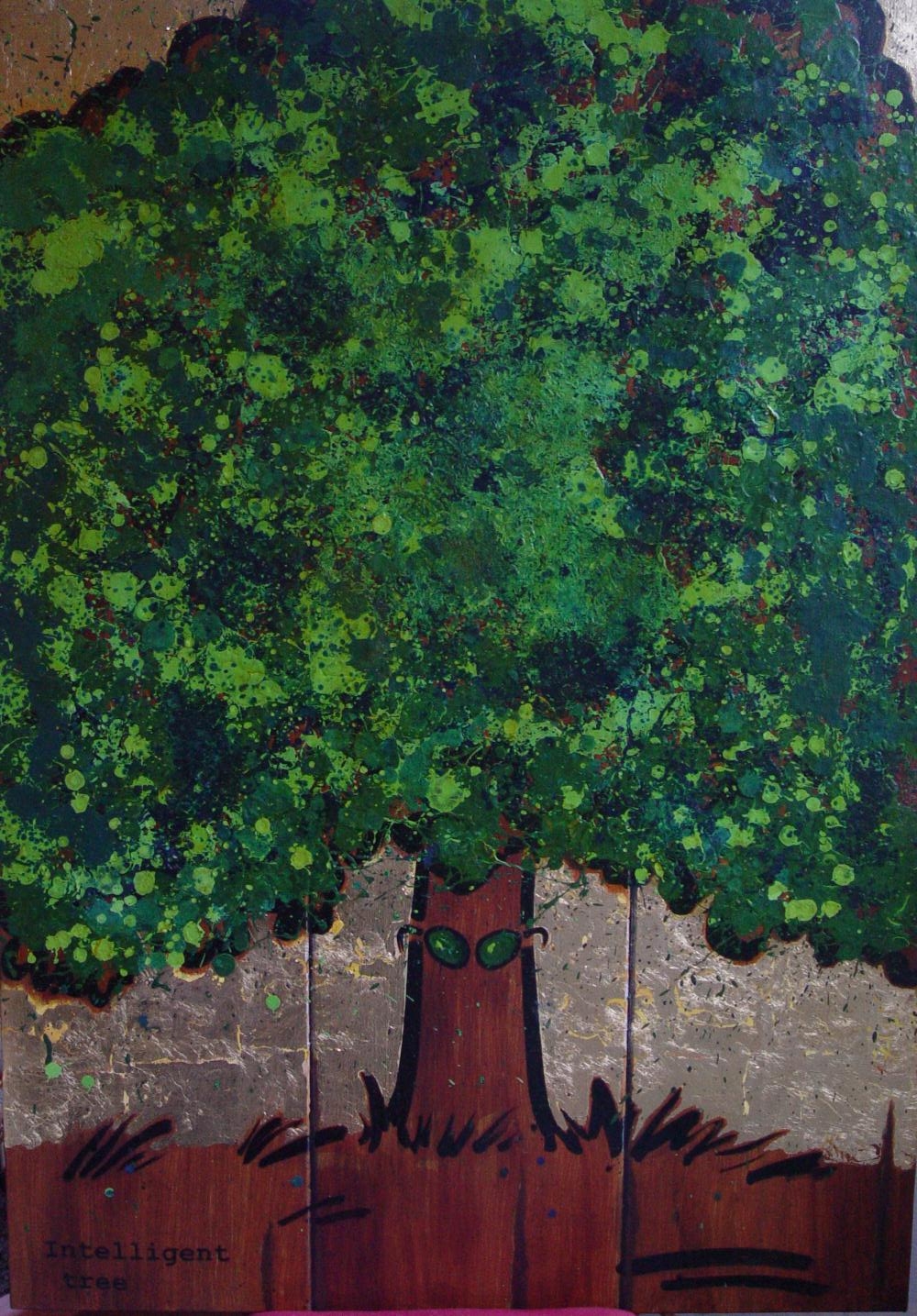
Intelligent tree, oils, acrylics and fax gold leaf on canvas

Migration, 1995, oils on canvas, 81 x 68 cm
This painting won a competition in Milan, I’m not sure where it is now.

Landscape below, 1999, acrylics on wood, 41 x 83 cm
This is a sketch that was inspired by me glimpsing a painting at a distance in a house in Udine, not understanding what it was and imagining that it was of a massive rift valley. The concept that I was thinking about was an exoplanet with a rift all the way around, so that there is one population living down in the valley, another population on top, and the only way that they can communicate is by means of hot air balloons (upwards).

L'isola dove andrò a morire, acrylics and faux gold leaf on canvas, 110 x 71 cm
A picture inspired by my trips sailing on the Mediterranean, now in the company of my courageous wife Sonia in our wonderful boat Ombra Vagabonda. In particular, there are two islands that we sail past on the way to France, Bergeggi and Gallinara.

Intelligent mushroom, 2006, wood, wire, plastic, h. 38 cm

Reflections on Milan, 1985, oils on canvas, 50 x 80 cm
When I arrived in Milan, I was fascinated by the skyscrapers and the reflections in their windows. I made a lot of paintings of these reflections. This painting is a bit different because there are some people outside the building.